The X-Trans Audit Part 2
The X100 Evolution—Unifying a Decade of Sensors
Introduction: The Myth of the "Magic Sensor"
In the Fujifilm community, there is an enduring belief that older sensors possess a "soul" that modern, high-resolution chips have traded for clinical precision. We’re told the X-Trans II (X100S) has an "organic" look, while the X-Trans IV (X100V) is "too digital."
But as I explored in Part 1, the "look" of a sensor is often just a byproduct of how the manufacturer chooses to "cripple" the color signal early in the development stage. In this post, we use the Cobalt Modular Handshake to normalize three generations of X100 cameras, proving that with the right colorimetric foundation, the hardware gap effectively disappears.
Image 1: The Heritage Guard (X100S / X-Trans II)
The Mission: Rescue a high-contrast street scene using the classic Leica M9 CCD look.
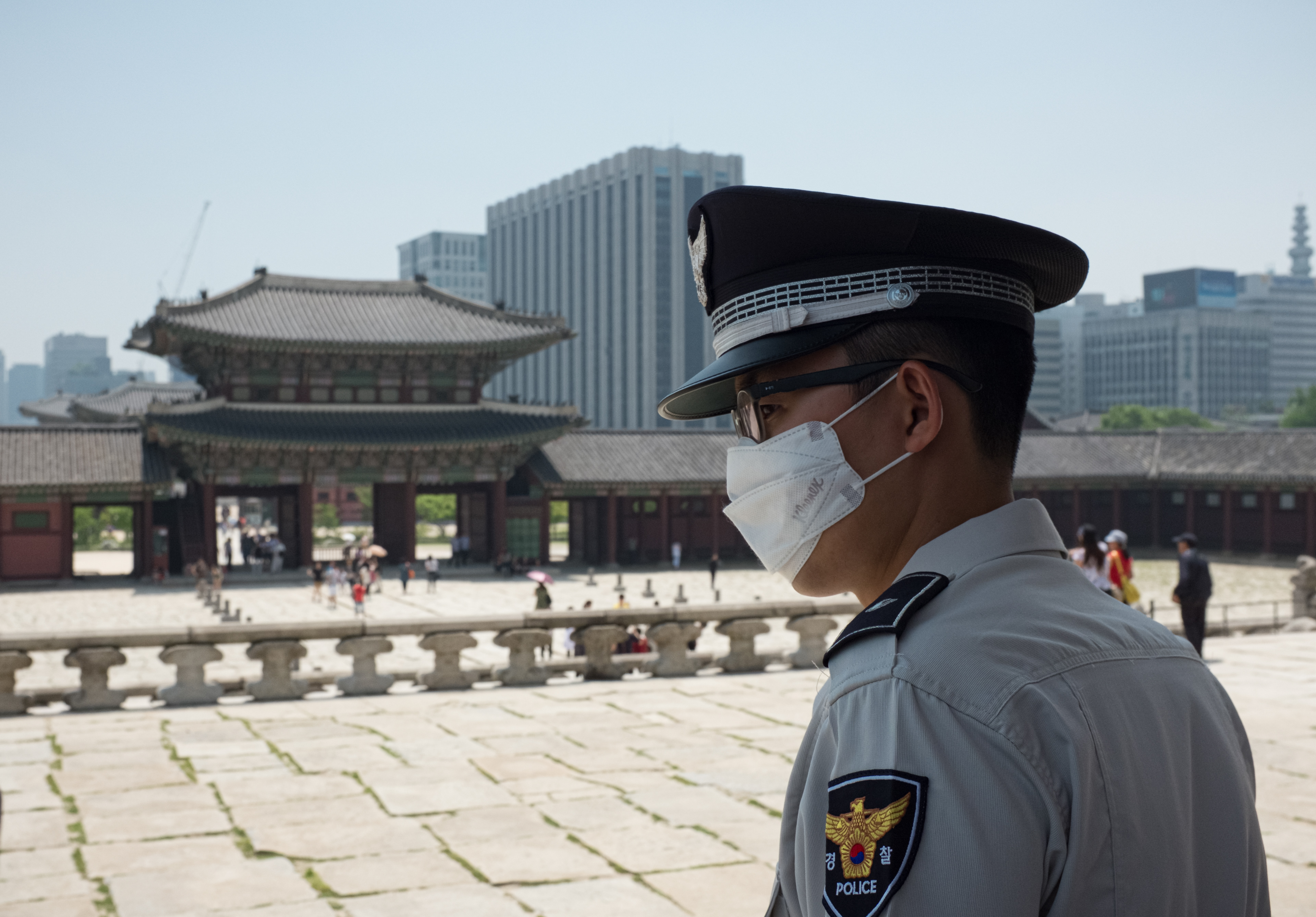
The 16MP X-Trans II sensor is the "vintage" heart of this trilogy. In this frame at Gyeongbokgung Palace, the histogram was hitting a cliff edge in the sky. By applying the Cobalt Modular Base and the Leica M9 CCD emulation, we didn't just recover highlights; we mapped them into a dense, filmic roll-off.
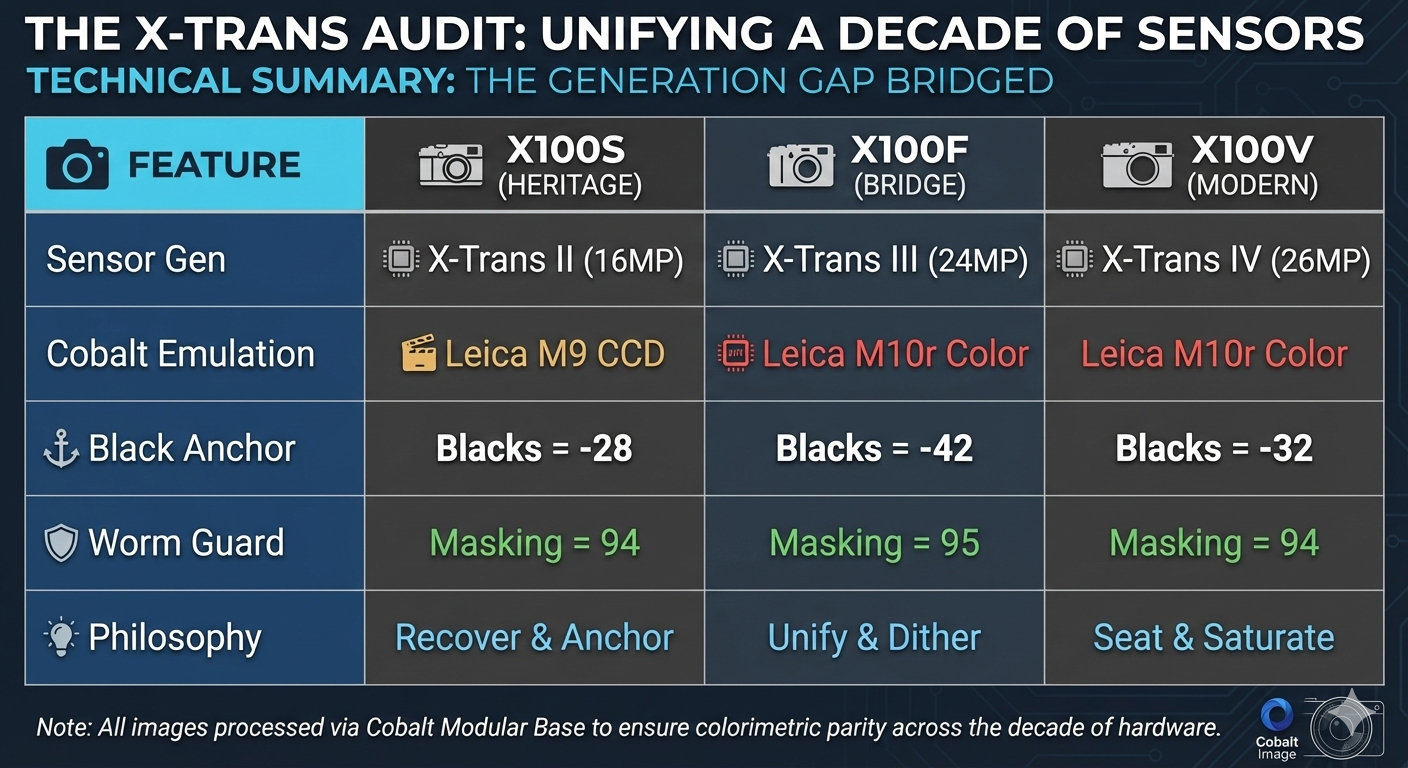
The Black Anchor: To prevent the 2013-era sensor from looking "veiled," I set a firm black point (Blacks = -28 ).
The Optical Filter: By dropping Blue Luminance to -32, we added tonal weight to the sky, mimicking a physical polarizer.
The Result: A file that looks like it came from a CCD-era Leica, despite being shot on a decade-old Fuji.
Image 2: The Interior Gaze (X100F / X-Trans III)
The Mission: Balance extreme window light and high-ISO noise (ISO 2500) using the Leica M10r Color look.

The X100F represents "The Bridge"—the moment Fujifilm sensors became professional-grade tools for high dynamic range. However, at ISO 2500, the digital noise can become "crunchy".
Normalization: We used the Leica M10r Color profile to handle the micro-contrast on the subject’s face.
Noise Strategy: Instead of aggressive noise reduction, we added a fine layer of digital grain (Amount 18) to "dither" the sensor noise into an organic texture.
Shadow Integrity: By pushing shadows to (+55) but maintaining a heavy Black Anchor (-42), we pulled detail from the bookshelf without the image feeling "thin".
Image 3: The Steampunk Parade (X100V / X-Trans IV)
The Mission: Taming a "clinical" modern sensor to achieve the dense Leica M10 aesthetic.
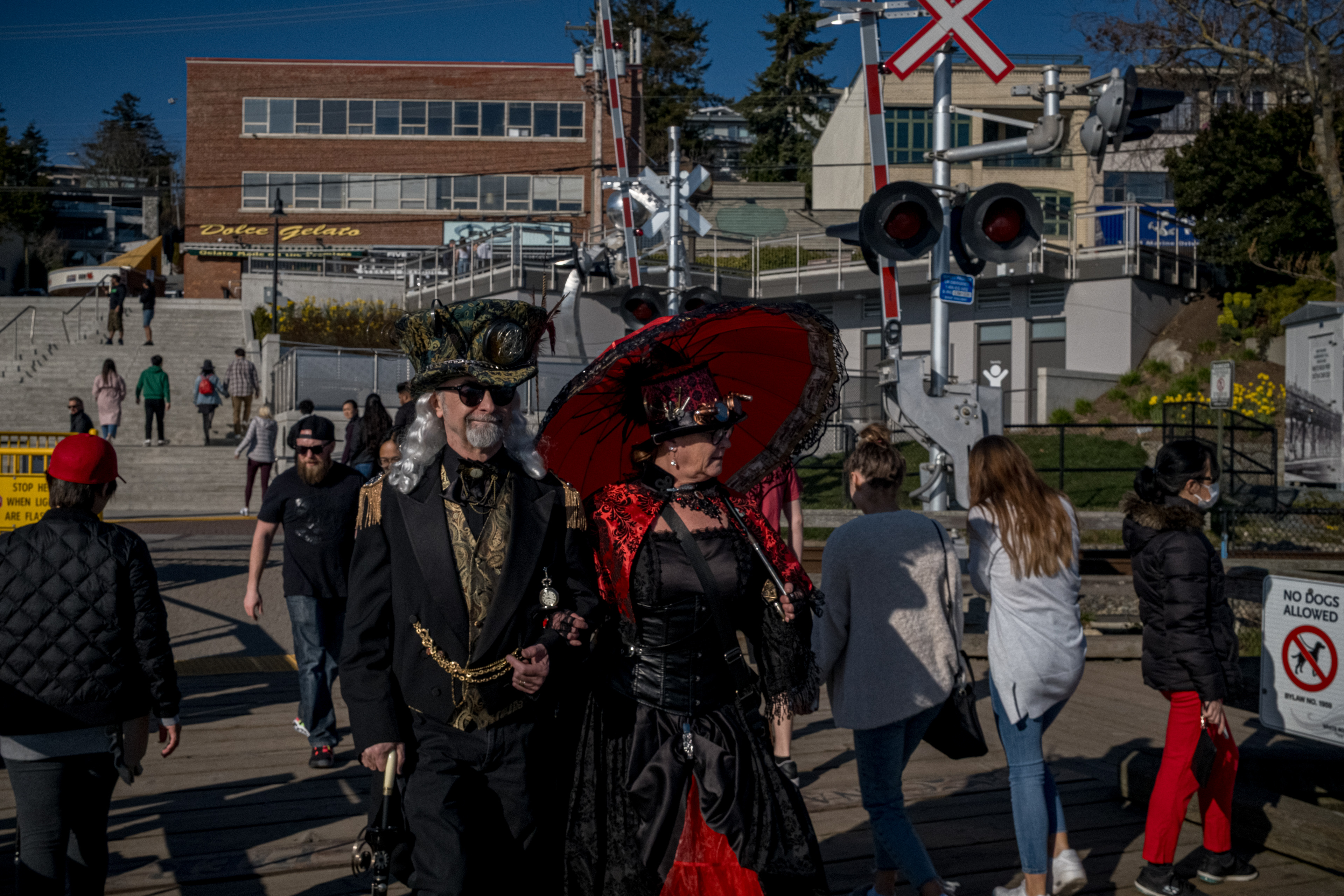
The X100V is the high-water mark of X-Trans precision. It is technically "perfect," which is often its weakness. To get the Leica look, we had to "seat the image under."
The M10 Logic: By pulling the exposure and mid-tones down, we move the data away from the "clinical middle" and into a state of high color density.
Worm Prevention: On this 26MP sensor, sharpening masking was set to 94 to ensure the costumes remained crisp without introducing X-Trans artifacts.
Color Integrity: Because Cobalt doesn't "compress the color too early," the reds in the umbrella and the skin tones of the couple remain distinct and vibrant, never muddy.
Conclusion: Consistency is a Choice
The takeaway for Part 2 is simple: stop buying cameras for their "film simulations". Buy them for their resolution and handling. By using a Modular Workflow, you can ensure your 2013 "heritage" files and your 2026 "modern" files sit side-by-side in a portfolio with perfect colorimetric parity.
Coming Next in Part 3: The Green War
The X-Trans Evolution doesn't stop at sensors—it lives in the foliage. For years, Fujifilm shooters have debated which generation truly "gets" greens: is it the organic, soulful rendering of the original X-T1, or the high-fidelity precision of the X-T4?
In our next installment, we put the "Fujifilm Smear" to the test. Using the Cobalt HSL "Optical Filter" logic, we will demonstrate how to extract maximum separation in forest landscapes without the "worming" artifacts that plague standard RAW converters.
The X-T1 vs. X-T4: A side-by-side battle for chlorophyll dominance.
Luminance over Saturation: How we use Cobalt to "weigh" greens instead of just painting them.
The Artifact Shield: Perfecting the Worm Guard for dense fine-art landscape printing.
Stay tuned as we move from the streets of Seoul to the deep greens of the wild.
Joe Ng Photography | Vancouver, BC
Merging the adrenaline of high-performance sports with the timeless beauty of global travel. A former Fujifilm X-Photographer applying a rigorous technical mindset to the Sony Alpha system.
Merging the adrenaline of high-performance sports with the timeless beauty of global travel. A former Fujifilm X-Photographer applying a rigorous technical mindset to the Sony Alpha system.